
Concrete Sealing in DeSoto TX - a slab that sheds water and still breathes
Water soaking into your driveway or patio and leaving dark patches? We seal it so water stays out and the concrete still breathes.
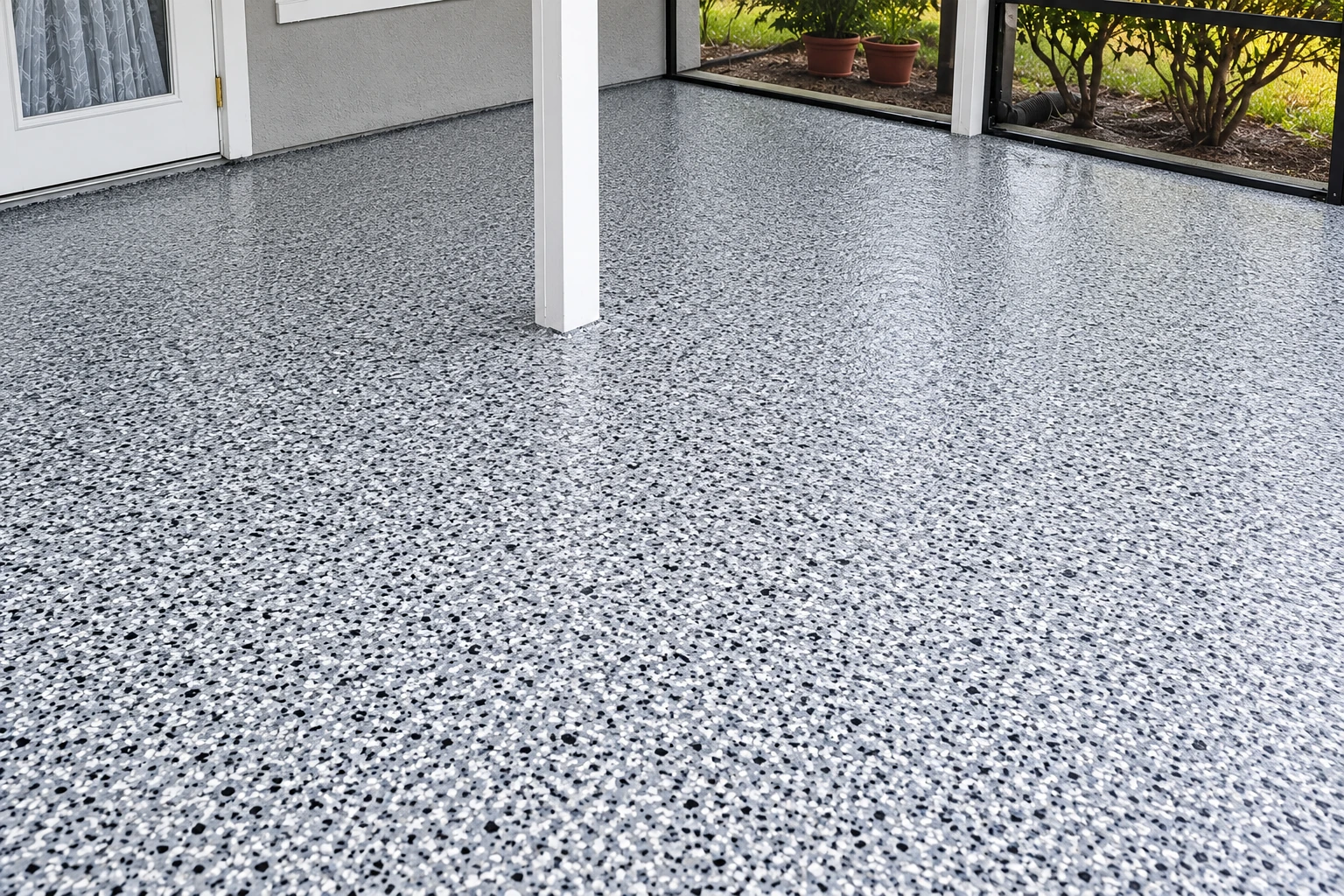
Should you seal your concrete in DeSoto?
Concrete sealing in DeSoto is a treatment that soaks into your driveway, patio, garage floor or pool deck and keeps water out, while letting moisture inside the slab escape so the concrete can breathe. At Slabline DeSoto Epoxy Flooring, we help you choose the sealer that suits your concrete and how it gets used.
Most homeowners call me once a driveway or patio starts soaking up every rain and turning dark, or once new concrete has gone in and they'd like to protect it from the start. The price moves with the size of the slab, how much cleaning and preparation it needs, and whether an old sealer has to come off first, and the schedule turns mostly on the weather and, for new concrete, how long it has cured. If the surface is pitted, worn or uneven, a sealer won't hide that, so concrete resurfacing or a self-leveling overlay may need to come first, and your estimate gives the figure for your own slab.
How do you know your concrete needs sealing?
Concrete usually shows you when it's taking on water or has lost its protection. These are the signs homeowners in DeSoto tend to notice before they call us about sealing.
Rain soaks in and leaves dark patches instead of beading up, which usually means the surface has no protection left.
Oil and fluid spills on the garage floor sink in and stain before you can wipe them up.
A white, chalky powder keeps showing up on the surface, which usually means water is moving through the concrete.
The surface is turning dusty or rough in the spots you walk or drive most, so the top layer is wearing down.
New concrete has finished curing and was never sealed, so it's been drinking up water from the start.
An old sealer is peeling, flaking or turning white, which usually means it went on too heavy and needs attention first.
If water is getting into a new slab or an old sealer is coming apart, it's worth calling now, because the longer it goes, the more cleanup the job needs first.
What happens when you call us about sealing your concrete?
Here's how a sealing job runs with us, from your first call to the final walk-through, and who you'll be dealing with at each step.
Call or send the form
Please call (972) 450-9481 or send the form, and tell us the slab's age, its rough size and any sealer used on it before. I'll set a time to come out and see it.
I look at the slab myself
I come out, measure the concrete and ask how it gets used, whether that's cars, foot traffic or a pool crowd. You then get a written estimate that names each step, so you know what you're paying for before you decide, and we settle on a time that works for you.
We prepare and seal it
Our own small crew cleans and prepares the concrete before any sealer goes down, because my father taught me a floor is only as good as the concrete under it. I'm on site running the work.
We walk the slab together
When the sealer is down, the crew cleans up and I walk the finished slab with you. I'll tell you when it's ready for feet and when it's ready for cars.
Get a written estimate for sealing your concrete
Send the form and we'll reply within one business day to set a time. I'll come out, look at the slab, and you'll get a free written estimate with no obligation.
- Call
- (972) 450-9481
- Hours
- Mon–Fri: 6 AM–10 PM, Sat–Sun: 7 AM–11 PM
Sealer types and where each one makes sense
A penetrating sealer soaks into the concrete instead of sitting on top as a film. Silane and siloxane are the common ones, and they leave the surface looking about the same as before, with no shine. In lab tests, an acrylic sealer blocked the concrete's pores, while the other sealers tested let air through about as well as bare concrete, which is worth knowing if you want the slab to keep breathing.
In lab tests, water-repellent sealers protected concrete that isn't in constant contact with water, because moisture vapor could still leave it. They may harm concrete that stays wet through repeated freezing and thawing, so sealing suits slabs that dry out between wettings, like most driveways and patios. That's why I ask how your slab drains and where water sits before I suggest anything.
We're based in DeSoto and work across the cities around it, and the whole Dallas-Fort Worth region sits on expansive clay soil that damages many thousands of home foundations every year. Slabs move and crack with that soil. A sealer keeps water out of the concrete, but it won't hold a slab still or close a crack, so I'll point out any movement I see before we talk about sealing.
Concrete sealing questions we hear in DeSoto
How much does it cost to seal a driveway in the Dallas area?
Sealing a driveway around Dallas usually costs about $200 to $850 per job. That's the going range in the area, not our price, and where your slab lands depends on its size, how much cleaning and preparation it needs, and whether old sealer has to come off. Your written estimate shows the figure for your slab, and the work is backed by our satisfaction guarantee.
What is the best sealer for a poured concrete slab?
For a dense poured slab, a silane is often the better fit, because its smaller molecules usually soak in deeper than a siloxane's. If you have a poured driveway or patio, it's fair to ask whether a silane suits it better, and I'll tell you what I'd choose for your slab and why.
How long does it take before I can walk or drive on sealed concrete?
One maker says to wait at least 4 to 6 hours before light foot traffic and 24 to 48 hours before cars or furniture go back, based on 70°F weather. Those times are for that one product, so I'll give you the wait for the sealer we actually put down on your slab.
How long should new concrete cure before it gets sealed?
One maker says newly poured concrete should cure for at least 28 days before sealing, and it calls surface preparation critical. The same maker calls for air between 50 and 90°F, out of direct sun, with no rain expected for 24 hours, so the day we seal depends partly on the forecast.
Can you put too much sealer on concrete?
Yes, one maker warns that putting its sealer on too heavily, in too many coats, or resealing too often can cause bubbling, whitening, peeling, flaking and failure. That's why we put down only as much as your concrete needs, and it's fair to ask any contractor how many coats they apply and how often they plan to reseal.
Do contractors have to register with the City of DeSoto?
Yes, the City of DeSoto requires every contractor to register each year, and DeSoto's Building Inspections Department at 972-230-9610 is the office to check with. We're licensed and insured. The city also requires permits for work that builds, alters or repairs a building or structure, and when a job of ours needs one, we pull it ourselves and plan around the city's inspections, and if I'm not sure, I check with the city's building office before I quote.
Related work that sometimes comes before sealing
Concrete Resurfacing & Overlays
If your slab is pitted, scaled or patched in spots, a new overlay gives it a fresh, even surface before any sealer goes on top.
Self-Leveling Concrete & Overlays
When an indoor floor dips, slopes or has low spots that hold water, a self-leveling layer brings it back to flat before it gets sealed or coated.
Ask for a concrete sealing estimate today
We're based in DeSoto and work across the cities around it, so please call (972) 450-9481 or use the estimate form even if your city isn't listed.
Mon–Fri: 6 AM–10 PM, Sat–Sun: 7 AM–11 PM